
StableSafe research ·
Stablecoin Depeg Risk: What to Check and How to Respond
What to do when a stablecoin depegs: verify the token, check redemption and liquidation risk, compare exit costs, and learn from USDC and TerraUSD.
Introduction
Your stablecoin shows $0.98. Selling 10,000 tokens would mean accepting roughly a $200 discount before trading costs. Waiting keeps you exposed to whatever caused the move. Which choice makes sense depends on the token's backing, your withdrawal route, and whether you have a loan attached to the position.
Start by confirming the exact token and getting a quote for the amount you hold. Then check the issuer or protocol's redemption status and any liquidation exposure. These checks tell you much more than the lowest price on a chart.
1. Find out what has actually depegged
A depeg is a deviation from a token's target value. For a dollar stablecoin, that target is usually $1, and the deviation can be above or below it. There is no universal percentage that separates an ordinary spread from a crisis. Breadth, duration, and redeemability help distinguish them.
Check the contract, chain, and quote currency
Native USDC and a third party's bridged USDC represent different claims. A bridge can lose access to backing while native USDC continues trading normally elsewhere. Use the issuer's contract list to identify the asset. Circle's bridged USDC explanation describes the additional claim on tokens locked on another chain.
A USDC/USDT price is a ratio between two tokens. If both fall against the dollar, the pair can remain near 1.00. Compare an independent dollar reference and executable quotes from more than one venue. Note the time, order size, and destination asset for each quote.
| Observation | Check next | What it helps distinguish |
|---|---|---|
| One pool or exchange shows a discount | Another liquid venue; quotes for your full size | A local liquidity problem from a broader move |
| Several independent venues move together | Issuer updates, redemption status, reserve evidence | A widespread repricing from one isolated quote |
| Only a bridged representation moves | Bridge backing, withdrawals, native token price | Bridge exposure from native issuer exposure |
| A vault share diverges | Assets per share, redemption preview, withdrawal limits | Normal yield accrual from a discount to the underlying claim |
If the disagreement is between a lending screen and a spot market, check which oracle the lending contract uses. Chainlink feeds update on heartbeat and deviation rules, so their timestamps and configurations matter during a fast move. A price difference by itself does not identify a broken oracle.
2. A discount can recover, or become a permanent loss
USDC, March 2023: access to reserve cash
During the Silicon Valley Bank failure, Circle had $3.3 billion of USDC reserve deposits at the bank, about 8% of the total reserve. On March 12, U.S. authorities announced that all SVB depositors would be protected and have access to their money the next day. Circle then reported that the reserve risk had been removed as the depeg closed.
Recovery followed a concrete change in access to the backing. The regulators' announcement is evidence for that event; it is no promise of support for a future one.
TerraUSD, May 2022: a failing stabilization mechanism
UST relied on conversion into $1 worth of newly issued LUNA to support its peg. As holders exited, that mechanism created more LUNA while demand for LUNA fell. The BIS account of the collapse describes UST falling to almost zero as confidence in both tokens disappeared.
These events produced very different outcomes. Ask what would make redemption work again: restored access to cash, sufficient collateral, a functioning bridge, or new buyers for another volatile token. A past recovery supplies no answer for a different mechanism.
3. Work out how the depeg reaches your position
Count the underlying exposure across wallets and protocols. Holding the same stablecoin in three lending markets still leaves you exposed to that issuer. A vault share can add a redemption dependency even if its symbol does not contain the stablecoin's name.
01 / Vault share
The vault must let you redeem its share for the underlying token.
02 / Bridged token
The bridge must release the native tokens backing its representation.
03 / Native token
Your account or intermediary must have a usable redemption route.
04 / Issuer reserves
The issuer must have access to sufficient assets to meet redemption.
Collateral and debt react differently
A fall in collateral value can push a loan toward liquidation. On Aave, the health factor compares threshold-adjusted collateral with debt value; a value below 1 makes a position eligible for liquidation. Watch the protocol's actual valuation and your debt, rather than assuming the stablecoin is valued at $1.
Illustrative loan, with all other inputs fixed
10,000 collateral tokens × $1 × 80% threshold ÷ $7,000 debt = 1.14 health factor.
At a $0.85 oracle price, the same calculation becomes 0.97.
The 80% threshold is hypothetical. Actual thresholds, oracle prices, and market settings vary. The example shows how a collateral depeg can cross the liquidation boundary.
If the weakening token is your debt instead, a lower oracle price can reduce the dollar value of that debt. The number of tokens you owe still remains, and a recovery can reverse that effect. Model both sides of the position before deciding how to repay or withdraw.
A lender with no borrow position has another constraint: available withdrawal liquidity. Aave withdrawals depend on unborrowed pool liquidity; withdrawing collateral can also be limited by an existing loan. A large TVL figure is not the amount available for immediate withdrawal.
Liquidity pools can change what you own
In a pool that lets traders sell the weakening token for a stronger one, those trades add the weakening token and remove the stronger token. Your LP claim can therefore become more concentrated in the asset falling in value. Inspect current balances and compare proportional withdrawal with a withdrawal into one coin; those routes can have different fees and outputs.
The displayed APY does not describe this exposure. A large fee spike during a sell-off can coexist with a falling value of the assets in the pool.
Savings tokens need the right benchmark
Many yield tokens represent shares whose value in underlying assets changes. For ERC-4626 vaults, a share and an underlying token are separate units. Compare the market quote with the current assets per share and the available redemption amount. A savings share trading above $1 can be normal; a discount to its redeemable asset value needs investigation.
4. Compare the money you can actually receive
Separate a chart price from an executable quote for your whole position. Then compare that quote with any redemption route you can personally use. Circle, for example, describes Circle Mint as a service for institutional customers. A retail holder may depend on an exchange or other intermediary to reach dollars.
| Route | Amount after costs | Access and timing |
|---|---|---|
| Market swap: 9,780 USDT received, less $6 network fee | $9,774 | If the quoted swap executes |
| Issuer redemption: $10,000, less $15 fee | $9,985 | Eligible account; assumed next business day |
In this example, waiting for the hypothetical redemption would return $211 more. Waiting also leaves the holder exposed until it completes. The comparison only helps if that holder is eligible and can tolerate the delay. An issuer's promise is of little use as an immediate exit route if you cannot access it.
Refresh quotes before signing. Check minimum received, network fees, the destination token, and exchange deposit or withdrawal status. Raising slippage tolerance permits a worse fill; it does not add liquidity to the market.
5. Choose a response from the evidence
A holder with an upcoming payment and an unleveraged long-term holder face different decisions. Set the maximum exposure you can carry, the time you need access to the money, and the events that would change your decision. Avoid adding fresh exposure while the cause remains unclear.
- If the move is confined to one market
- Compare routes and check the exact contract. Moving immediately through that thin market may incur a larger loss than using another available venue. Continue checking whether the same discount spreads elsewhere.
- If your loan is close to liquidation
- Evaluate repayment or additional unaffected collateral using the protocol's own health factor. Withdrawing collateral can worsen the position. A recovering spot price may not arrive before a liquidation transaction.
- If redemptions or backing are impaired
- Evaluate reducing exposure using routes that still function, at a quote you can accept. A promised return to $1 needs evidence about the backing and redemption process. A high APY provides no evidence of either.
- If you decide to wait
- Write down what supports that decision and when you will review it: a completed redemption, a dated reserve update, restored bridge operation, or sufficient executable liquidity. Keep enough native gas token to act on the relevant chain.
For future alerts, record the contract, chain, price source, deviation, and time outside your chosen range. Price persistence and confirmation across independent markets can help filter isolated quotes. Choose alert settings to trigger a review; their usefulness depends on the asset and the position, rather than a universal automatic sell rule.
6. Use StableSafe to review the next allocation
Once you have assessed the immediate position, use the yield explorer to compare the protocol, token, chain, APY, TVL, and risk score of prospective markets. These are useful inputs for comparing opportunities. Check available withdrawal liquidity and current incident information on the protocol itself.
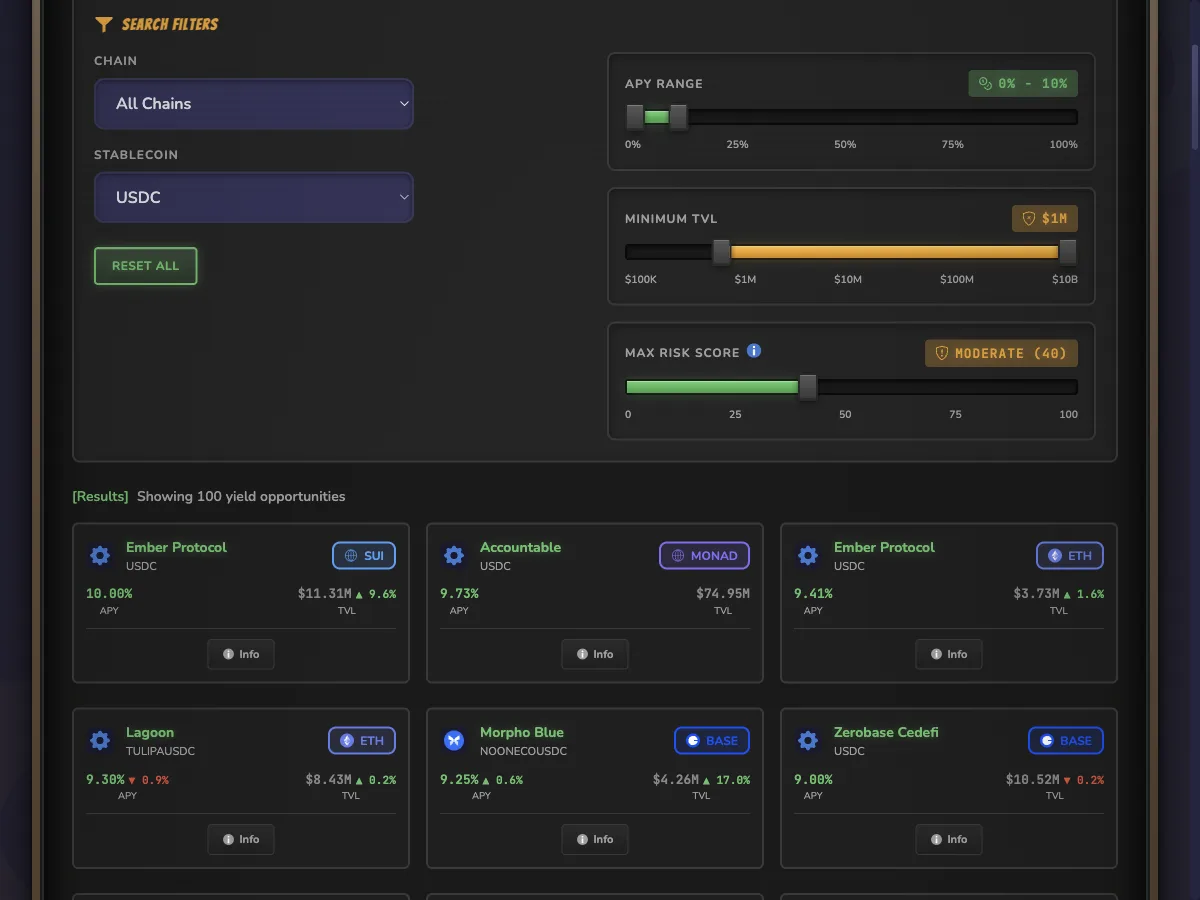
Group proposed deposits by their shared issuer and mechanism as well as by protocol. Splitting USDC across two protocols diversifies some protocol exposure but keeps the same issuer exposure. Read the stablecoin safety comparison for issuer questions and the lending platform guide for market selection.
Compare current stablecoin yieldsCommon depeg questions
- Does withdrawing from a lending protocol remove depeg risk?
- Withdrawing normally returns the underlying token. Holding that same token in your wallet retains its issuer or mechanism exposure, although it changes the protocol exposure. Converting it or redeeming it is a separate step.
- Is a stablecoin at $0.99 a bargain?
- Only a reliable and accessible recovery or redemption route can close that discount. Fees, eligibility, timing, and the possibility of a loss in backing all affect the outcome. A previous $1 price does not set a floor.
- Can a savings token be healthy above $1?
- Yes. A vault share can represent more than one underlying token as yield accrues. Compare it with the current redemption value and withdrawal terms. Our yield-bearing token guide compares the extra layers in those products.
Sources and review date
Reviewed October 27, 2026. Historical examples describe their stated event dates. Live reserve reports, lending parameters, and redemption terms should be checked again during an active event.
- Circle: USDC reserve risk and the March 2023 depeg
- Treasury, Federal Reserve, and FDIC: March 12, 2023 joint statement
- BIS: the collapse of TerraUSD, Annual Economic Report 2022, Box A
- Circle: native and bridged USDC
- Circle Mint: institutional minting and redemption access
- Aave: health factor and liquidations
- Aave: withdrawal liquidity and collateral constraints
- Chainlink: feed updates and timestamp checks
- ERC-4626: vault shares, underlying assets, and withdrawal limits