
Safest Stablecoins in 2026: Independent Safety Rankings
Ranked list of the safest stablecoins in 2026 with independent safety scores. Compare USDC, USDT, DAI, USDe, PYUSD, and RLUSD by reserve quality, regulatory status, audit history, and depeg track record.
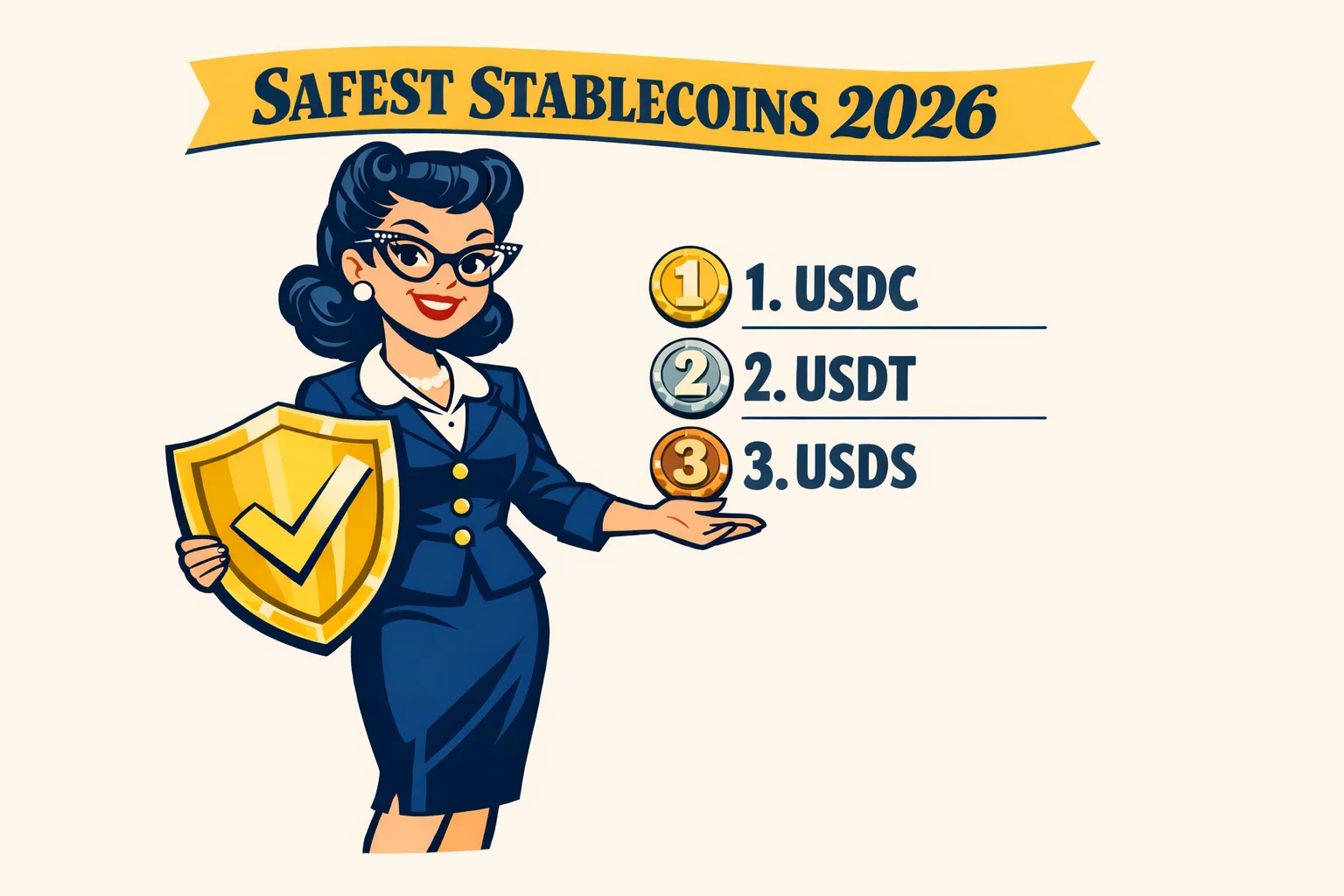
Not all stablecoins are equally safe. Reserve composition, audit transparency, regulatory status, and depeg history vary dramatically between issuers. With the stablecoin market now exceeding $300 billion and the GENIUS Act reshaping regulatory requirements, knowing which stablecoins you can trust matters more than ever. This guide ranks the major stablecoins by safety based on verifiable data -- not marketing claims.
How we evaluate stablecoin safety
Our safety assessment considers five factors. No single metric tells the full story -- a stablecoin can have strong reserves but weak transparency, or solid audits but regulatory uncertainty.
What assets back the stablecoin? US Treasuries and cash are safest. Secured loans, crypto collateral, and opaque holdings add risk.
How often are reserves attested, and by whom? Monthly attestations by a Big Four firm are the gold standard. Quarterly or opaque reports are a red flag.
Is the issuer registered and compliant? GENIUS Act compliance in the US and MiCA in the EU provide legal protections that unregulated stablecoins lack.
Has the stablecoin maintained its peg through market stress? Stablecoins that survived the SVB crisis and 2022 bear market without structural failure have proven resilience.
Fiat-backed stablecoins carry different risks than crypto-collateralized or algorithmic ones. Simpler mechanisms generally mean fewer failure modes.
We also reference external ratings from S&P Global (1-5 scale, lower is better) and Bluechip (letter grades A+ to F) where available.
2026 stablecoin safety rankings at a glance
| Stablecoin | Type | Market Cap | S&P | Bluechip | Safety Tier |
|---|---|---|---|---|---|
| USDC | Fiat-backed | $56B | 2 (Strong) | B+ | High |
| DAI / USDS | Crypto-collateral | $15B | 4 (Constrained) | B+ | High |
| USDT | Fiat-backed | $140B+ | 4 (Constrained) | D | Medium |
| PYUSD | Fiat-backed | $1B+ | - | - | Medium-High |
| RLUSD | Fiat-backed | <$1B | - | - | Medium-High |
| USDe | Delta-neutral | $7B | - | - | Lower |
| FDUSD | Fiat-backed | $2B | 4 (Constrained) | - | Lower |
| FRAX | Hybrid | <$1B | 5 (Weak) | - | Lower |
Market cap figures are approximate as of early 2026. S&P and Bluechip ratings reflect the most recent published assessments.
USDC (Circle) - High Safety
USDC is the highest-rated major stablecoin by S&P Global. Circle publishes monthly reserve attestations through Deloitte showing exactly what backs each token. As of October 2025, USDC reserves consisted of 35% US Treasuries, 53% repurchase agreements, and 12% cash -- all highly liquid, low-risk assets.
Circle is pursuing GENIUS Act compliance and is applying for a federal bank charter. S&P noted that full GENIUS Act implementation could upgrade USDC's score, as the law explicitly prioritizes stablecoin holders in bankruptcy proceedings -- the main factor currently preventing a "1 (Very Strong)" rating.
Depeg history: USDC briefly fell to $0.87 in March 2023 after Silicon Valley Bank collapsed (Circle held ~$3.3B at SVB). The peg fully recovered within days once FDIC guaranteed deposits.
Available on: Ethereum, Arbitrum, Base, Polygon, Solana, Optimism, Avalanche, and other major chains.
USDT (Tether) - Medium Safety
USDT is the largest stablecoin by market cap and the most widely traded. However, its safety profile is weaker than USDC in several areas. Tether publishes quarterly attestations (not monthly) through BDO, and reserves include categories beyond Treasuries and cash -- notably over $7 billion in secured loans whose counterparties and terms remain undisclosed.
S&P rates USDT at 4 (Constrained), citing concerns about reserve transparency and governance. Bluechip assigns a D grade. In the EU, USDT faces compliance challenges under MiCA regulations, leading several European exchanges to delist it.
Tether launched USAT (USA Tether) in January 2026 through Anchorage Digital Bank specifically for the US market under GENIUS Act oversight, suggesting even Tether recognizes the need for a more regulated offering.
Depeg history: USDT dropped to $0.95 during the Terra/Luna crash in May 2022 but recovered within days. It has maintained its peg through subsequent crises.
Why it still matters: Despite lower safety ratings, USDT has the deepest liquidity of any stablecoin. Many DeFi pools require USDT, and its trading volume exceeds all other stablecoins combined.
DAI / USDS (MakerDAO / Sky) - High Safety
DAI is the original decentralized stablecoin, backed by over-collateralized crypto assets and real-world assets (RWA) including US Treasuries. In 2024, MakerDAO rebranded to Sky Protocol and introduced USDS as the upgraded version of DAI. Both tokens coexist, with DAI at ~$5.4B market cap and USDS at ~$10B.
The over-collateralization model means every $1 of DAI/USDS is backed by more than $1 of collateral. This provides a buffer against market drops -- though extreme volatility can still trigger liquidations. The mix of crypto collateral and Treasuries diversifies risk compared to purely fiat-backed stablecoins.
S&P rates DAI/USDS at 4 (Constrained) due to governance complexity and crypto collateral volatility, while Bluechip gives a B+ for its strong decentralization and transparency. The yield-bearing variant sDAI earns the DAI Savings Rate automatically.
Depeg history: DAI has maintained its peg through multiple market crises since 2017, including the March 2020 crash and the 2022 bear market. Brief deviations have been small and short-lived.
USDe (Ethena) - Lower Safety
USDe uses a delta-neutral strategy: it holds crypto collateral (Bitcoin, ETH, staked ETH) and opens matching short positions on perpetual futures to hedge price exposure. The yield comes from staking rewards and funding rate arbitrage. This mechanism is fundamentally different from fiat-backed stablecoins and carries unique risks.
October 2025 depeg: During a $20 billion liquidation event triggered by US-China trade tensions, USDe dropped to $0.65. The protocol's TVL halved from $14.8 billion to $7.4 billion with $8 billion in outflows. This was a structural stress test that exposed the risks of delta-neutral mechanisms during extreme market conditions.
Key risks include negative funding rates in bear markets that can deplete reserves, reliance on centralized exchanges (Binance, Bybit, OKX) for the futures leg, and operational complexity that leaves room for execution errors.
Best for: Experienced DeFi users who understand the mechanism and want higher yields through sUSDe. Not suitable for users seeking savings-account-level safety.
PYUSD (PayPal) - Medium-High Safety
PYUSD is issued by Paxos Trust Company on behalf of PayPal, regulated by the New York Department of Financial Services (NYDFS). Reserves are held in US dollar deposits and short-term US Treasuries. Paxos publishes monthly reserve attestations.
PayPal's institutional backing and regulatory compliance give PYUSD strong credibility. The PYUSDx platform enables cross-chain transfers and integration with Fiserv payment networks. However, PYUSD's relatively small market cap means lower liquidity than USDC or USDT, which limits its availability in DeFi protocols.
Depeg history: No significant depeg events since launch.
RLUSD (Ripple) - Medium-High Safety
RLUSD is Ripple's fiat-backed stablecoin, approved by NYDFS and backed by US dollar deposits, US Treasuries, and US government money market funds. Ripple has committed to monthly third-party attestations.
Available on the XRP Ledger and Ethereum, with listings on Kraken, Bitstamp, and other major exchanges. Ripple's push into Japan through SBI Holdings and its existing cross-border payments infrastructure give RLUSD a clear use case.
Caveat: RLUSD is very new with limited track record. The regulatory foundation is strong, but it has not yet been tested through a market crisis.
The GENIUS Act: what it means for stablecoin safety
Signed into law in July 2025, the Guiding and Establishing National Innovation for US Stablecoins (GENIUS) Act is the first comprehensive US stablecoin law. It establishes clear safety requirements that directly affect which stablecoins you should trust:
Reserves must match or exceed outstanding stablecoins at all times. Qualified assets include US dollars, Federal Reserve deposits, Treasury bills (93 days or shorter), overnight repos backed by Treasuries, and government money market funds.
Issuers cannot lend out, pledge, or reuse reserve assets for their own benefit. Reserves must be segregated from operational funds.
Stablecoin holders are explicitly prioritized in bankruptcy proceedings. This was the main factor S&P cited as limiting USDC's rating -- once fully implemented, it could trigger upgrades.
Customers must have a clear, enforceable right to redeem stablecoins for US dollars on demand. Fees must be disclosed and capped.
Stablecoins that comply with the GENIUS Act offer stronger legal protections than those operating outside US regulatory frameworks. When choosing a stablecoin, regulatory status should be a key factor in your safety assessment.
Major stablecoin depeg events
A stablecoin's track record through stress is one of the best indicators of its resilience. Here are the most significant depeg events to understand:
Cause: Algorithmic mechanism collapsed under redemption pressure. $40B wiped out.
Outcome: Total loss. UST never recovered. Led to industry-wide regulation push.
Cause: Contagion from Terra collapse triggered panic selling.
Outcome: Recovered within days. Reserves held.
Cause: Silicon Valley Bank collapse. Circle had ~$3.3B deposited at SVB.
Outcome: Fully recovered after FDIC guaranteed deposits. Peg restored in days.
Cause: Justin Sun alleged First Digital Trust was insolvent. Sparked panic.
Outcome: Partially recovered to ~$0.98. First Digital denied claims and filed lawsuit.
Cause: SIP-420 lowered collateralization ratio from 750% to 200%.
Outcome: Slow recovery. Reached $0.93 by mid-August 2025. Full re-peg targeted mid-2026.
Cause: $20B market liquidation event. Delta-neutral strategy stressed.
Outcome: TVL halved. $8B in outflows. Highlighted mechanism risk.
The bottom line
If safety is your primary concern, USDC is the strongest choice based on reserve transparency, S&P rating, and regulatory trajectory. DAI/USDS offers decentralization with strong over-collateralization but adds governance complexity. USDT has unmatched liquidity but weaker transparency and regulatory standing.
For yield-seeking users, the stablecoin you deposit matters as much as the protocol you deposit it into. A safe protocol holding a risky stablecoin still carries the depeg risk of that stablecoin. StableSafe's Pool Finder factors in both protocol risk and stablecoin risk to give you a complete picture.
Diversifying across stablecoins -- not just protocols -- is a practical way to reduce your exposure to any single issuer's failure. If one stablecoin depegs, your losses are limited to the portion allocated to it. See our yield safety guide for more on building a diversified stablecoin strategy.

Find the safest stablecoin yield opportunities across 100+ protocols and 15+ chains.